
In the early years of legalization, retailers benefited from novelty and access. Legal cannabis was new, and brands were quick to innovate across formats to fill shelves and attract attention. Simply being open and well-stocked was often enough to drive revenue. Today, there is no shortage of products, or retailers, but what is constrained is shelf space, purchasing budgets, and ultimately customers’ willingness to add more to their baskets.
An important shift for retailers requires looking at cannabis through a behavioral lens rather than a product lens. Adding another high-THC SKU rarely creates incremental growth opportunities, as it redistributes existing demand across a crowded set of similar products. The customer still walks out with what they intended to buy; the brand may change, but the total spend does not. So the question is, how do retailers gain incrementality in their assortment?
- Market shift: High-THC products are saturating, but 58% of consumers are actively seeking lower-potency, “light” options.
- Incremental growth: Baskets containing “light” cannabis products have a C$6.44 higher average transaction value than those without.
- Customer loyalty: More than 51% of light cannabis purchases come from existing loyalty members, indicating strong repeat behavior.
- Merchandising strategy: Success requires moving away from the “weak” stigma by framing low-dose products around social use cases (e.g., “patio pre-rolls” or “game night gummies”).
Why consumer demand is shifting toward lower potency
Many of today’s high-THC products are built around similar use cases rather than expanding how cannabis fits into day-to-day life. That approach continues to serve a core segment of the market, particularly heavy users, but it does little to introduce them to new occasions or bring in different types of consumers.
Research conducted by the nonprofit Angus Reid Institute on behalf of the Ontario Cannabis Store found 58 percent of consumers actively seek lower-potency products, spanning the cannacurious, casual consumers, wellness seekers, and even steady, experienced users. The data reflects a broader shift toward moderation and control.
That trend is not unique to Canada. Markets like Colorado have seen increased interest in lower-potency products as consumers look for options with more functionality. When products are designed with quality inputs for controlled, predictable experiences, they begin to serve a different role in the assortment. Instead of competing for the same purchase, they become an addition.
The impact of ‘light’ cannabis on basket size and revenue
Basket insights collected from Lite Label retail partners show notable patterns. Baskets that include a light product are consistently larger, with average transaction value increasing by C$6.44. Gross margin trends slightly higher as well, moving from 36.7 percent to 37.2 percent. More telling is the repeat behavior. More than half of purchases (51.7 percent) are made by existing loyalty members, reinforcing that light cannabis is not just attracting new consumers but also being adopted by experienced ones as part of their regular purchasing pattern. In an industry where many products struggle to drive retention, that distinction matters.
The data is clear: Light cannabis isn’t a replacement for high-THC products; it is a premium add-on.
The reason the light phenomenon works comes down to how customers make decisions in-store. When most of the assortment serves the same purpose, the decision typically defaults to price. When a product introduces a new use case, it becomes easier to justify adding the product to the basket without replacing something else. The challenge is that this works only if the retail environment supports the pattern.
Dispensary merchandising: moving beyond the ‘weak’ stigma
In many dispensaries, lighter cannabis is still positioned as a lesser option and may be considered “low-quality” or “weak,” rather than high-quality and light by design. That framing limits the products’ relevance and often leads to them being overlooked. “Light” is also frequently conflated with wellness products, which tend to focus on balanced formulations that incorporate CBD, CBN, or CBG in addition to THC. As a result, the distinct role of light-THC products remains underdeveloped, and in many cases the category itself is still relatively empty and an untapped growth opportunity.
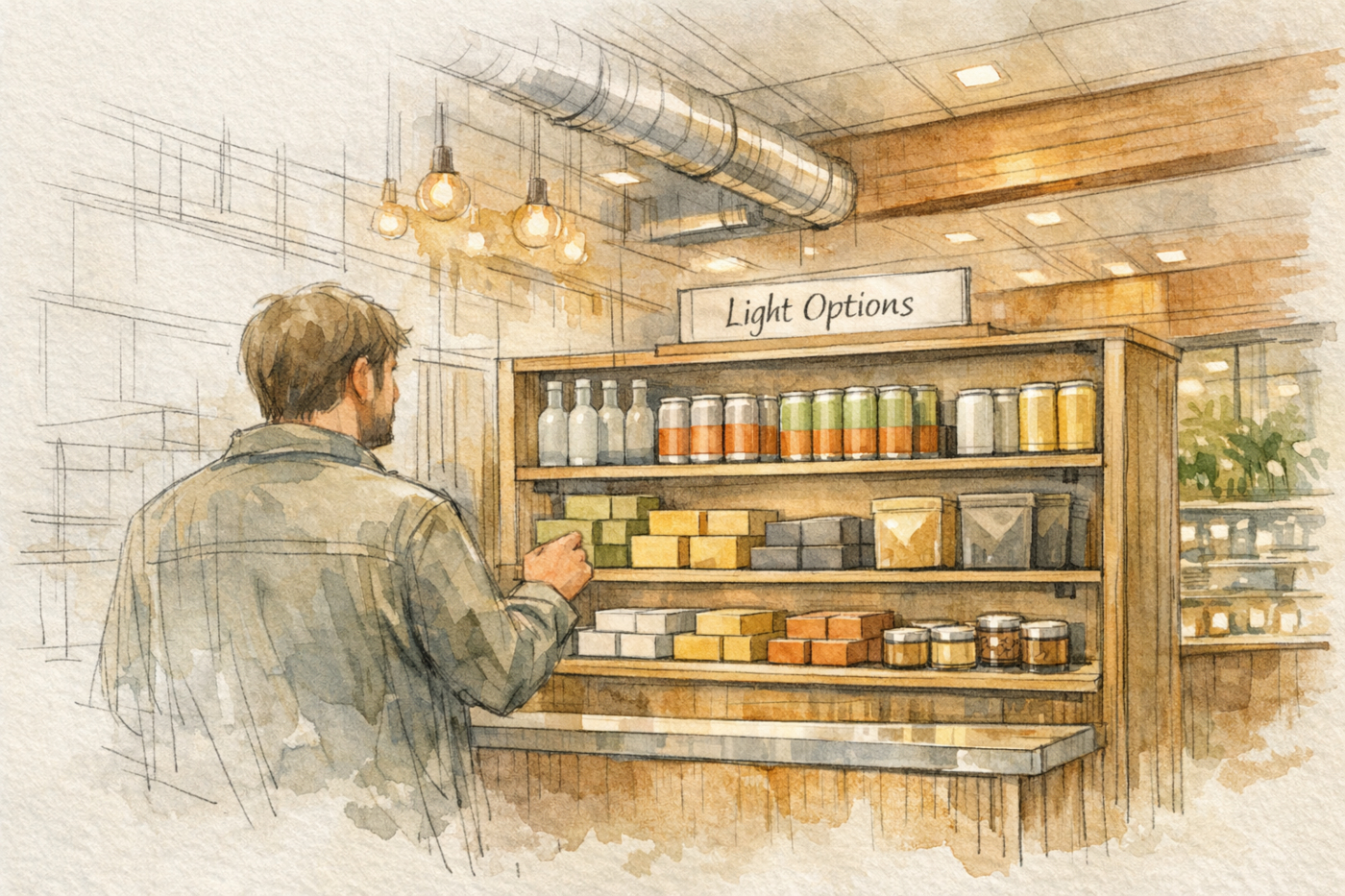
The stores that see stronger performance are the ones that shift the narrative. They anchor low-dose products in familiar use cases that customers already understand, like a social pre-roll that fits a patio and a park or a multipack of microdose gummies that are perfect for game night. These are simple, relatable concepts that make it easier for customers to see where the product fits and justify adding it at the counter.
The future of shelf space: prioritizing incremental growth
Retailers are looking for sustainable growth, which doesn’t always come from carrying more of the same. Brands must have a vested interest in their retail partnerships, and that means showing why their products deserve shelf space and changing how customers shop.
Light cannabis earns its place when it introduces new occasions, increases basket size, and builds repeat behavior among customers. In a saturated market, that is the kind of contribution that justifies shelf space. When executed with intent, introducing low-dose products gives existing consumers a reason to spend more and opens the door for consumers who may not yet have found a comfortable entry point.

Wendy Milne is president of Go Brands, a cannabis brand portfolio committed to establishing the light category in Canadian cannabis. Previously, she served in senior executive roles at Canopy Growth Corporation and Labatt Breweries of Canada. She possesses more than fifteen years of leadership experience across cannabis, beverage alcohol, investment banking, professional sports, and travel and tourism. Milne has held roles across trade marketing, sales, retail, commercial planning, and operations, giving her a deep understanding of how integrated go-to-market strategies actually drive results. She has helped establish seed-to-sale value chains, build and scale sales processes, and navigate the complex marketing realities of the cannabis industry.