






According to Grand View Research, cannabis tourism generated approximately $10.23 billion in 2023. Grand View analysts project the sector will hit $23.73 billion by 2030. While optimistic forecasts are welcome, those of us working in this tightly regulated industry have good reason to doubt the United States market will experience such rapid growth.
Take Colorado, for example. Despite being a mature adult-use market, the state’s Department of Revenue has reported year-over-year declines in cannabis spending since 2021. In 2024, sales reached their lowest point since 2018.

There’s no singular cause for the drop, but the novelty of visiting Colorado for a legal high may have worn off. With twenty-four states offering legal adult use and others enabling thriving hemp-derived THC markets, there’s less incentive to travel. If a similar experience is available nearby, why fly?
Ironically, this decline has led many dispensaries, especially those near airports, to ask whether they should invest in outbound digital advertising aimed at incoming tourists. While the logic is understandable, my agency wanted to know if the idea had legs or was just wishful thinking. So, we conducted a consumer survey to find out.
Advertising to tourists at the airport is a form of awareness play. The idea: A visitor lands, opens their phone, sees your ad, and either places an order or remembers your brand later when searching for a dispensary. There’s a catch, though: One impression is rarely enough.
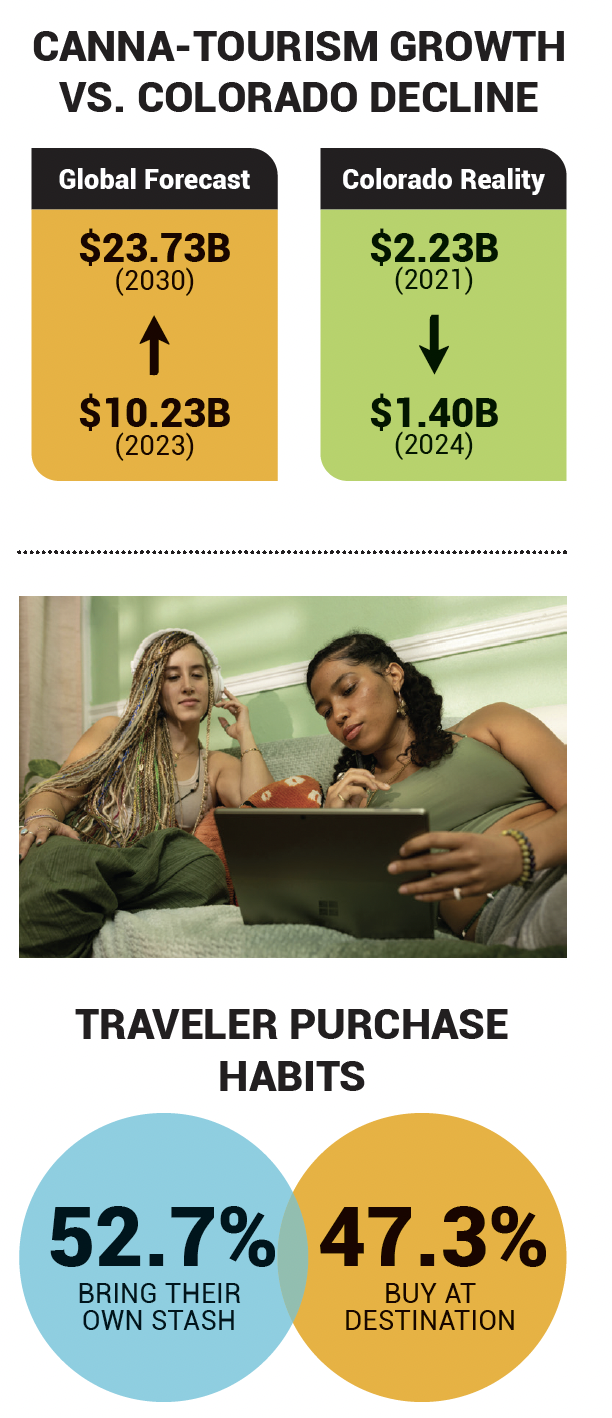
The tourist survey we conducted revealed 52.7 percent of traveling consumers bring their stash with them, while 47.3 percent buy at their destination. That’s nearly a fifty-fifty split, which is great news for dispensaries hoping to serve travelers, even if they’re not visiting for cannabis alone.
But survey respondents ranked airport proximity dead last among the criteria they consider when searching for a dispensary while on the road. In addition, most out-of-towners don’t search by dispensary name. Instead, like locals, they search for “dispensary near me.” This means brand visibility in local search is far more impactful than a flashy banner ad at baggage claim.
Whether you’re marketing to locals or tourists, your first priority should be making sure your business is optimized for search by focusing on your local audience. According to Forbes, acquiring a new customer can cost up to seven times more than retaining an existing one. That makes locals the better investment for most dispensary marketing budgets, especially considering most tourists who responded to our survey indicated dispensary recommendations from friends and locals were nearly as influential as product selection and price. Locals aren’t just your most valuable customers; they’re also your best marketers.
Ultimately, how people find you matters more than who they are. Search catches people at the moment they’re ready to buy.
In May 2024, a massive Google algorithm documentation leak gave search engine optimization (SEO) professionals an unprecedented look into how search rankings actually work. While SEO pros long had relied on inferences and clues, the leak confirmed many longstanding assumptions and uncovered some new priorities that matter a lot for dispensaries.
One of the most important priorities the documentation revealed is the way Google Business Profiles (GBPs) influence the search algorithm. If you haven’t already claimed a profile for your business, do so immediately. Then optimize it.
Dispensaries face stricter advertising limits than traditional businesses, but a GBP is one of the few places that doesn’t censor cannabis businesses. Better yet, all businesses—traditional and plant-centered alike—play by the same GBP rules.
GBPs show up in local search results based on relevance, reviews, and proximity. Dispensaries must ensure they categorize themselves as a “cannabis store.” Otherwise, they risk not showing up in search results for terms like “dispensary near me.”
GBPs also collect reviews, much like businesses represented on Yelp and other directories, and both review volume and positivity matter. Encourage customers to leave a review on your business’s profile.
Google’s leaked docs also revealed something else: The search giant evaluates businesses as entities, and websites are only part of the whole. In addition to considering website traffic and reviews, Google looks at how businesses are talked about across the web and whether their website’s content indicates they are an authority in their field.
Consequently, a good strategy for boosting your appearance in search engine results is to focus your content on what you sell and where you sell it. Every page should reinforce your identity as a cannabis retailer in a specific location. If your site includes a blog or educational content, draw a clear line from every topic back to cannabis products and purchasing.
Another surprise: Conventional SEO wisdom leaned heavily on the value of backlinks, which are links from other respected sites to yours. It turns out Google now cares less about backlinks than it does about mentions. If authoritative industry publications or other relevant sites are talking about your business, that sends a strong authority signal. The most impactful signals are those with a clear cannabis context.
This is one of the clearest takeaways from the leak: Positive mentions from relevant, trustworthy sources help establish your business as legitimate and successful in its sector.
One way to gain mentions is through well-thought-out, meaningful public relations campaigns. Media citation campaigns are a foundational local SEO tactic. Another type of tried-and-true citation campaign involves submitting your dispensary’s details (name, address, phone number, hours, etc.) to reputable business directories and local listing services. Listing your business in multiple directories proves the operation is real and open to the public. Accuracy counts here, so police the listings every so often to ensure they remain up to date. Conflicting directory information can harm a dispensary’s Google visibility.
Also ensure your website has a unique page for each physical dispensary location. Your homepage can’t be expected to rank for every local query. At our agency, we follow a simple philosophy: One page per keyword. That means if you want customers to find you when searching for a “dispensary near Capitol Hill,” your site should include a page dedicated to that specific location. If you operate a dispensary in Dupont Circle, for example, a page devoted to that dispensary might mention the distance to the Capitol complex along with hours of operation, products, and prices.
Location pages can help you rank locally and create a better user experience. They allow dispensary chains to include detailed info about each store—directions, parking, product menus, events—so the customer doesn’t have to dig.
In addition to traditional SEO strategies, businesses need to be aware of the emergence of search results augmented by artificial intelligence (AI). We are in the midst of a transition from traditional search to AI search.
There are some complex technical considerations that AI favors in search results, but for the most part dispensaries should focus on ensuring these answer engines have enough information about and trust in your business to recommend it when consumers ask relevant questions.
Dispensary marketing budgets often are limited, so make every dollar work smarter by boosting organic visibility. Start with a Google Business Profile. Optimize your site’s content. Build out citations by earning relevant mentions. And above all else, invest in strategies that build trust and visibility for the long term. Search optimization is a long game. Success won’t be an overnight accomplishment, but it will have lasting value once achieved.
Dispensary SEO and AI Search: Key Questions Answered
Why is local SEO important for dispensaries?
Local SEO ensures dispensaries appear in searches like “dispensary near me,” capturing consumers at the moment they’re ready to buy.
How do Google Business Profiles impact dispensary marketing?
GBPs influence rankings by relevance, reviews, and proximity, making them essential for cannabis retailers to claim and optimize.
Should dispensaries focus more on locals or tourists?
Locals provide higher long-term value and word-of-mouth marketing, while tourists are more opportunistic buyers.
Do backlinks still matter for dispensary SEO?
Backlinks are less important than authoritative mentions from cannabis-related media and directories.
How is AI changing dispensary search results?
AI-powered search engines prioritize businesses with strong profiles, accurate citations, and trusted mentions, making optimized content even more important.

Based in Denver, Tyler Jacobson is director of marketing at Hybrid Marketing Co., a full-service creative agency serving highly regulated industries including cannabis and hemp. With more than twenty years of digital marketing experience, he specializes in turning visions into actionable outcomes by understanding customer needs, simplifying complexity, and aligning teams around shared goals.
Related Articles: