

Vireo Growth’s announcement that it will acquire Planet 13 emphasized the assets and projected scale typical of a major acquisition: a marquee Las Vegas superstore, a Florida footprint, and a path to becoming the country’s largest dispensary operator by store count. What the announcement did not emphasize is that Vireo is paying a premium for a company whose first-quarter revenue fell by roughly one-quarter as its net loss quadrupled.
The gap between the deal’s projected value and Planet 13’s recent financial performance is the actual story.
- Vireo agreed to acquire Planet 13 in an all-stock transaction carrying a premium over its recent trading price.
- The acquisition would add 36 dispensaries and strategically useful assets in Nevada and Florida.
- Planet 13’s first-quarter revenue declined 24.8 percent as its net loss quadrupled year over year.
- Vireo’s projected 265-store footprint depends on multiple announced and pending transactions closing and integrating successfully.
- Planet 13’s assets may prove more valuable within Vireo, but the acquisition’s success remains an execution question.
The terms of Vireo’s Planet 13 acquisition
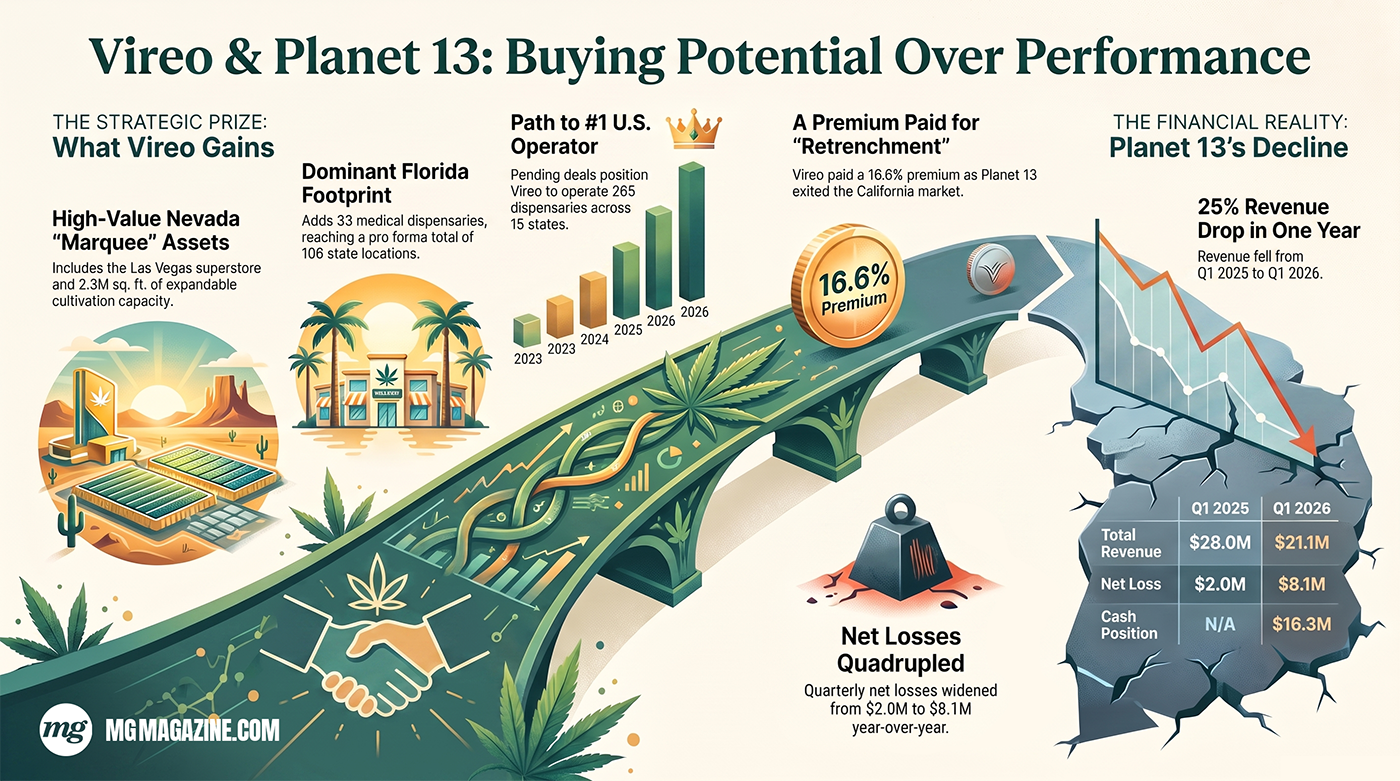
The companies announced July 27 that Vireo had agreed to acquire Planet 13 in an all-stock transaction. The deal remains subject to Planet 13 shareholder approval, regulatory approvals, and other customary closing conditions. Each Planet 13 share will convert into 0.015383618 of a Vireo subordinate voting share, a ratio the companies say represents a 16.6-percent premium over Planet 13’s 20-day volume-weighted average price as of July 24, and a 24-percent premium over the July 24 closing price.
What Vireo gains in Nevada and Florida
The headline figure is 36 dispensaries, but the more useful way to read the deal is by market and asset quality rather than store count.
In Nevada, Vireo picks up Planet 13’s Las Vegas superstore, one additional dispensary, about 45,000 square feet of active cultivation and production capacity, roughly 2.3 million square feet of expandable cultivation and production facilities, a distribution license, and a cannabis consumption lounge license. In Florida, the acquisition adds about 33 medical-only dispensaries and two cultivation and production facilities totaling more than 76,000 square feet. In Illinois, a limited-license state, it adds a Waukegan dispensary.
That’s a meaningful package independent of what Planet 13’s income statement looks like. Florida density could give Vireo greater route-to-consumer reach and purchasing leverage. The companies indicated the combined footprint would reach 106 dispensaries in the state on a pro forma basis. Nevada still carries brand visibility, tourism exposure, and licensing advantages. Illinois is a minor piece of this particular deal, but scarcity value in a limited-license state doesn’t require volume to matter.
Vireo has said this deal, combined with previously announced and pending transactions — including a separate $35-million agreement to acquire up to 25 dispensaries from The Cannabist Company Holdings Inc. — would leave it operating about 265 dispensaries across 15 states, positioning it as the largest cannabis operator by dispensary count in the United States.
That framing is worth pausing on. “Following completion of all previously announced and pending acquisitions” is pro forma language, not a description of Vireo’s current footprint. It’s an outcome that depends on multiple separate transactions closing and then successfully integrating, not a certainty baked into this one announcement.
Planet 13’s recent financial performance
Planet 13 has spent eight years as one of the licensed cannabis industry’s most visible retail brands, built substantially around its Las Vegas superstore. That visibility did not prevent a sharp deterioration in the company’s first-quarter results. In first-quarter 2026, the company reported revenue of $21.1 million, down 24.8 percent from $28.0 million a year earlier, and a net loss of $8.1 million, compared with a $2.0-million net loss in the same quarter of 2025. The company held $16.3 million in cash and restricted cash as of March 31.
That decline follows Planet 13’s February announcement that it had substantially completed its exit from California, a move framed around streamlining operations toward what the company called core growth markets — Nevada and Florida specifically. Read alongside the Q1 numbers, that’s the language of a company narrowing its footprint and reallocating capital after an earlier growth map stopped paying off, not one expanding from a position of strength.
Florida supplied Planet 13 with a much broader retail footprint, but the additional locations were not sufficient to produce stronger consolidated results by the first quarter.
Taken together, the Nevada and Florida assets look less like an acquisition of a thriving operator than a purchase of the core pieces remaining after Planet 13’s retrenchment.
Vireo’s stock-funded acquisition strategy
The premium itself is being paid in Vireo shares, not cash, which is consistent with how Vireo has funded much of its recent expansion. Worth noting for anyone comparing deal sizes across Vireo’s 2026 announcements: The company completed a 30-for-1 consolidation of its subordinate voting, multiple voting, and super voting shares effective June 5, 2026, so share counts and exchange ratios from deals announced before that date aren’t on the same basis as the Planet 13 terms. Several of the company’s other announced or completed deals this year have leaned on the same structure. Before Vireo’s June consolidation, The Hawthorne Gardening Company acquisition involved 213 million shares and warrants to purchase another 80 million — the equivalent of approximately 7.1 million shares and 2.67 million warrants on a post-consolidation basis. The Eaze Inc. acquisition was an all-stock deal; the FarmX LLC deal included $12 million paid in Vireo shares alongside cash. Vireo also assumed liabilities as part of its acquisition of Bridgewell Agribusiness.
None of that is disqualifying on its own. Stock-funded acquisitions allow a company to expand without using as much cash at closing, and Vireo reported $137.8 million in cash at the end of the first quarter. But cash, $106.2 million in GAAP revenue, and $32.7 million in adjusted EBITDA — a non-GAAP measure — do not reveal the full cost of this acquisition campaign. A pattern of stock-funded deals executed at this pace raises a straightforward question for existing shareholders: How much ownership is being issued to assemble a footprint that still must be integrated, and what will Vireo’s obligations look like once debt, seller financing, capital requirements, and other pending commitments are counted alongside the pro forma store total? That’s a balance-sheet question this deal alone doesn’t answer, and it’s worth its own closer look once more of Vireo’s pending transactions actually have closed.
The pro forma framing shows up elsewhere in Vireo’s own numbers, too. Alongside its $106.2 million in actual first-quarter GAAP revenue, Vireo separately reported $210.2 million in pro forma revenue — roughly double the reported GAAP figure, and a reminder that the company’s growth narrative leans heavily on acquisitions that hadn’t yet contributed a full quarter’s results at the time they were announced.
The execution question
Vireo is betting Planet 13’s assets — the Las Vegas flagship, the Florida density, a foothold in the limited-license Illinois market — are worth more inside a larger operating platform than they were as part of a shrinking business. That’s a defensible bet. It’s also not the same as saying the deal has already proven itself.
For now, the more accurate read isn’t that this signals a new era of cannabis consolidation. It’s narrower: Vireo has agreed to pay a real premium in an all-stock transaction for a company whose most recent numbers were moving in the wrong direction. The case for that premium rests entirely on whether Vireo can produce better results from those assets than Planet 13 has recently delivered.