

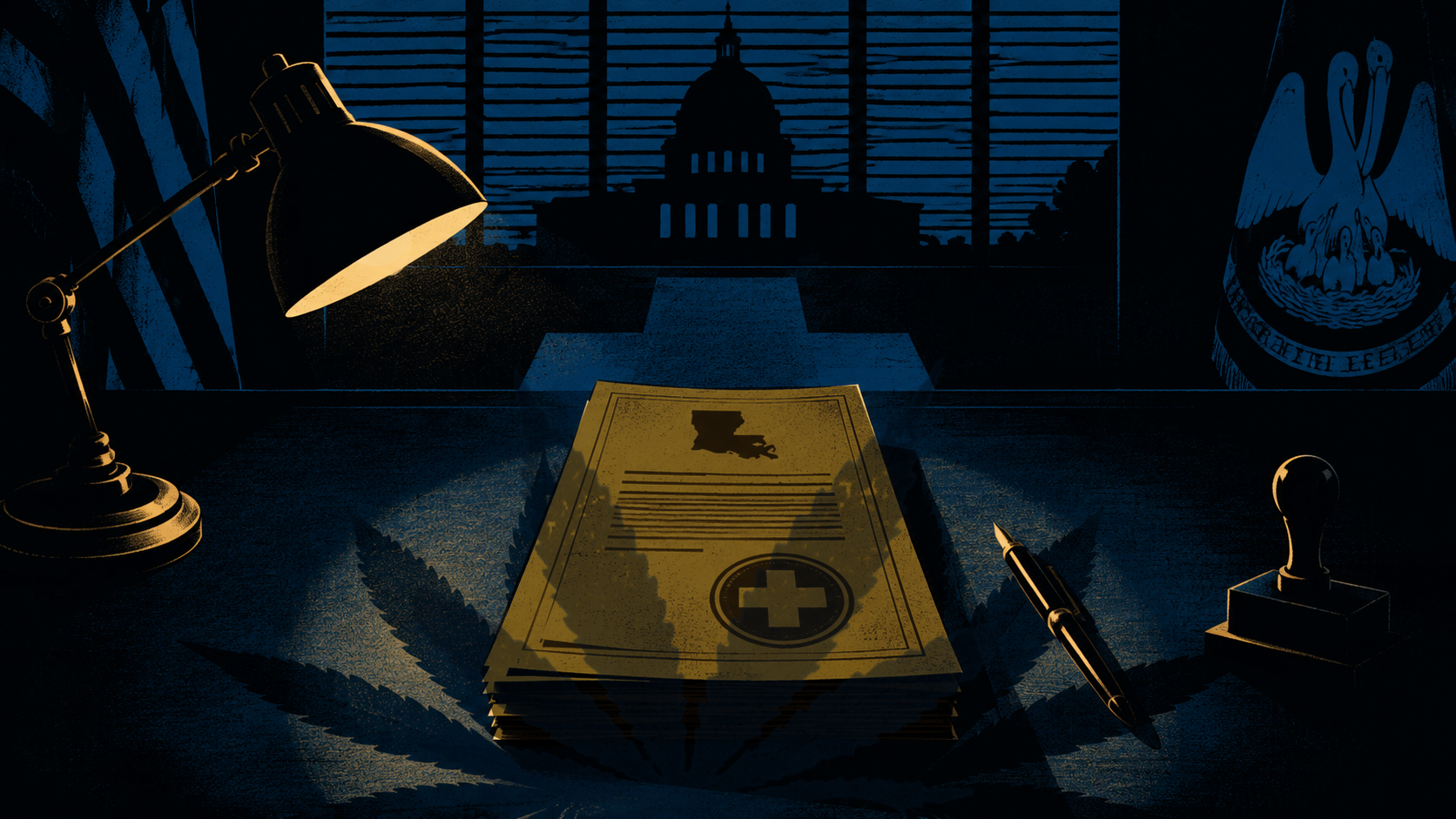
BATON ROUGE, La. – In a state where smoking or vaping cannabis within 2,000 feet of a school is a felony, Louisiana’s legislature did something unexpected: It passed a bill allowing terminally ill patients to use medical cannabis inside hospitals. Even more surprising was the margin. The legislation secured a nearly unanimous 33-2 vote in the Senate and cleared the House 53-45.
Senate Bill 270, authored by State Sen. Katrina Jackson-Andrews (D), now awaits action from Republican Gov. Jeff Landry. The governor has until June 10 to sign, veto, or allow the bill to become law without his signature. If it clears his desk, the law will take effect August 1.
- Timeline: Louisiana SB 270 is on Gov. Jeff Landry’s desk. If signed or left unsigned by June 10, it takes effect August 1.
- Hospital mandate: The bill requires hospitals to establish written guidelines allowing terminally ill patients to use non-smoking, non-vaping forms of medical cannabis on-site.
- Patient responsibility: Patients or primary caregivers are solely responsible for acquiring, storing (in a locked container), and administering the medicine. Healthcare staff are legally prohibited from touching it.
- Federal escape clause: Hospitals can immediately opt out of the policy if federal officials take cannabis-related enforcement action against any healthcare facility in the state.
- Narrow scope: The law is strictly tailored to end-of-life comfort and does not create an institutional B2B sales channel.
“This bill was brought at the request of constituents who believe therapeutic medical marijuana, which is already legal in this state, should be offered in hospitals when patients are terminally ill or otherwise in need of the comfort of this medicine,” Jackson-Andrews told the Senate Health and Welfare Committee.
Unless Landry issues an outright veto, Louisiana will become only the second U.S. state to protect end-of-life care for hospital patients. Since January 2022, California’s Compassionate Access to Medical Cannabis Act (“Ryan’s Law”) has required acute care hospitals, hospices, skilled nursing facilities, and congregate living facilities to permit terminally ill patients and some chronically ill seniors to self-administer. Similar measures are moving through legislatures in Colorado, Hawai’i, Pennsylvania, Virginia, and Washington.
Importantly, the Louisiana bill does not create a new product category, licensing tier, or retail model. Instead, it systematically removes a specific, heartbreaking barrier: the forced choice between inpatient end-of-life care and legal cannabis therapy.
What SB 270 requires
Under the bill, hospitals must create written protocols permitting covered patients — those with terminal and irreversible conditions, a prognosis of one year or less, and a valid medical marijuana registration — to use medical cannabis on-site. The products must be consumed in forms other than smoking or vaping. Emergency rooms and outpatient departments are explicitly exempt.
Operationally, the compliance burden stays entirely off the hospital’s books. Patients must source their own products and store them securely in a locked container they provide. Healthcare professionals are explicitly banned from “administering, storing, retrieving, or assisting” with the cannabis.
This strict boundary was no accident. It was shaped in part through collaboration between the bill’s sponsor and the Louisiana Hospital Association, which participated in drafting the Senate committee amendment that finalized the legislation’s scope. Hospitals are merely required to permit the policy, not manage the inventory.
The federal opt-out clause
The most consequential provision for the medical industry — and the one most likely to dictate the bill’s real-world footprint — is the sweeping opt-out clause.
Under the finalized language, a hospital may instantly halt its medical cannabis policy if federal regulators take enforcement action against any healthcare facility in the state. This is a significantly broader safety valve than earlier drafts, which allowed only an individual, targeted facility to opt out.
The practical reality? If federal authorities move against a single Louisiana facility over cannabis compliance, the entire state hospital network can dismantle their programs overnight. Whether that trigger ever is pulled depends heavily on how the Department of Justice and the Department of Health and Human Services manage enforcement priorities amid the ongoing federal rescheduling process.
What SB 270 means for operators
Louisiana dispensaries and product manufacturers serving sensitive patient demographics should carefully note what this legislation opens — and what it keeps locked down.
A new product environment
Because smoking and vaping are strictly prohibited inside hospital walls, this segment relies entirely on non-combustible product formats. Operators should optimize inventory for high-potency, predictable delivery formats like tinctures, capsules, precise edibles, and transdermal patches.
A logistical patient shift
The bill opens a legal channel inside hospital rooms, allowing families to maintain palliative care regimens without fear of security intervention. It turns inpatient rooms into a legal consumption zone for pre-purchased products.
Zero institutional B2B access
The bill does not create a hospital supply chain. There will be no state hospital formularies, institutional purchasing orders, or bedside hospital dispensing. The supply chain still begins at the independent dispensary counter and ends with the patient or caregiver.
What depends on Landry
The governor hasn’t signaled a position publicly. Louisiana’s medical cannabis program has grown under his administration without major executive interference, but SB 270’s bipartisan legislative support doesn’t guarantee a signature. Advocates and operators should watch for action — or, alternatively, inaction — in early June.
The broader Louisiana picture
SB 270’s progression is remarkable given the broader context of the current legislative session, which advanced multiple bills pointing in opposite directions. The same session yielded House Bill 568 (signed into law in May), which mandates harsh felony penalties for smoking or vaping cannabis near school zones or college campuses. Conversely, lawmakers also approved HCR111, which authorizes a task force to study adult-use legalization, and SB 43, a psychedelic-assisted therapy pilot program funded by opioid settlement dollars. The latter unanimously passed the legislature in late May and awaits the governor’s signature.
The through-line is not ideological consistency; it is constituent pressure on specific, narrow issues. Jackson-Andrews’ bill succeeded, in part, because it is difficult to vote against a dying patient’s comfort. Operators should view SB 270 as a massive win for compassionate care in a deeply conservative state but avoid reading it as a green light for broader adult-use reform in the future.