

For years, the cannabis edibles category was a creative playground — a space where brands could experiment with flavor, texture, and effect, often operating like high-end craft kitchens.
Today, the “wild west” era of craft-scale production is hitting a wall. Behind the scenes, the category is growing up, and the growing pains are becoming expensive. With global edibles sales on track to surpass $55 billion over the next decade, this is no longer a niche category; it is a high-stakes manufacturing race.
The brands that will be here in 2030 aren’t necessarily the ones with the flashiest packaging. They are the ones with the most disciplined production floors.
- The scaling wall: The artisanal, “test kitchen” approach to edibles is hitting an expensive barrier as the category heads toward a projected $55-billion market.
- The gummy volatility: Minor environmental shifts — like a 5% drop in humidity or a 30-second cooking variance — can ruin thousands of dollars in product and compromise dosing safety.
- The engineering shift: Survival for high-volume producers requires moving away from the “chef mindset” and adopting standardized, pre-stabilized ingredient foundations to guarantee brand consistency and protect profit margins.
The costly reality of gummy manufacturing variables
Gummies have become the industry’s go-to format for a reason: They’re familiar and shelf-stable, and consumers love them for consistency. But what looks simple on a retail shelf is a technical masterpiece behind the curtain.
I’ve seen thousands of dollars worth of product turn into a sticky, unsalvageable mess because a room’s humidity dropped by 5 percent or a cook time was off by thirty seconds. In the early days, we called this the cost of doing business. Today, it’s a mistake that can sink a brand.
Gummies are one of the most technically sensitive products. Small changes in temperature, timing, or ingredient ratios can affect taste, of course, but more importantly they compromise dosing accuracy, clarity, and safety. These variables multiply as you scale.
Scaling edibles: shifting from test kitchens to MSO production lines
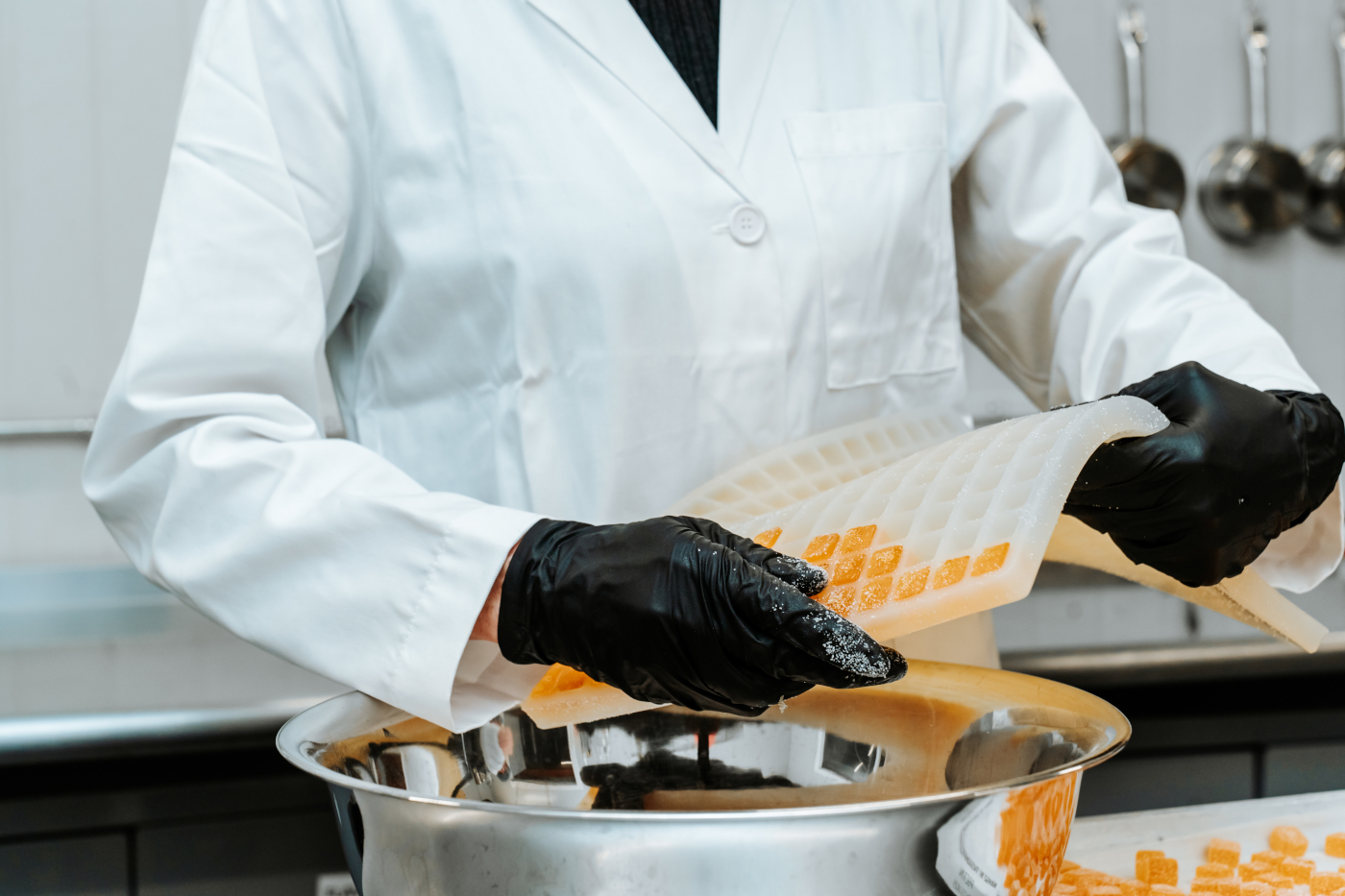
In the early days, recipes evolved batch by batch. If the texture was slightly off, the lead cook adjusted on the fly. That intuitive approach works in a test kitchen, but it’s a liability on a multistate operator’s (MSO’s) production line.
There’s a common fear in our industry that standardization is the death of creativity. I argue the opposite. Standardization is the only way creativity survives at scale. A Michelin-star chef doesn’t reinvent the physics of a roux every night; they rely on a perfectly calibrated kitchen so they can focus on the artistry of the dish. Cannabis must adopt the same mindset. Growth depends on repeatability — not just great ideas, but systems that can execute those ideas consistently across five different states with five different crews.
Formulations vs. equipment: identifying bottlenecks in edibles production
One of the biggest misconceptions in edibles is that bottlenecks are caused by equipment or staffing. In reality, the silent killer of margins is usually the formulation.
If your base system isn’t 100-percent stable, everything downstream suffers. Your production team spends more time “firefighting” than producing. The Friday afternoon panic, where a batch fails to set and a delivery deadline is missed, is almost always a failure of the system, not a person.
Consistency is no longer a quality goal; it is your most aggressive competitor.
Scaling requires a psychological shift: moving from a mindset of experimentation to one of control.
The case for industrial standardization and pre-stabilized bases
As the industry matures, we are seeing a shift toward semi-finished ingredient systems, a practice long used by the global food giants. Instead of rebuilding a gummy formulation from scratch for every batch, smart operators are using stabilized foundational components.
By standardizing the gummy base, manufacturers can:
- Reduce cook times by up to 50 percent, immediately increasing throughput.
- Eliminate human error in the most volatile stages of the cook.
- Focus on differentiation, spending their energy on unique cannabinoids, terpenes, and flavors rather than worrying whether the gelatin will set.
Protecting margins and multistate brand consistency
As markets expand, consistency is the baseline. If a consumer buys your gummy in Massachusetts and then again in Florida, and the texture or effect is different, you haven’t lost just a sale. You’ve also lost a brand advocate.
Beyond the consumer, there is the reality of margin pressure. Failed batches and extended development cycles are silent margin-killers. In a tightening market, the difference between a brand that scales and one that stalls is the ability to deliver the same product at scale, without sacrificing efficiency.
The future of cannabis edibles: prioritizing execution over novelty
The edibles category is entering a new phase defined less by novelty and more by execution. The “how” is now more important than the “what.” We have to stop thinking like chefs and start thinking like engineers. Edibles brands’ survival depends on building a process that can deliver a great product over and over again, no matter where or how it’s produced.
In this industry, consistency isn’t just a goal. It’s the ultimate competitive advantage.

Sarah McLaughlin, MS, RD, co-founded Melt-to-Make™, a food technology company specializing in gummy manufacturing solutions. She serves as the company’s as vice president of product development and research. With a background in nutrition, biochemistry, and food science, she focuses on developing systems that improve consistency and scalability in edible production. Previously, she served as a sports dietitian for the University of New Hampshire Athletic Department and as a dietitian for St. Luke’s Wood River Medical Center. She also developed the Sun Valley Bar, a natural whole foods energy bar acquired by The Bountiful Company.