

Cannabis retailers have spent years teaching customers to shop the deal.
Now the deal may be becoming the everyday price.
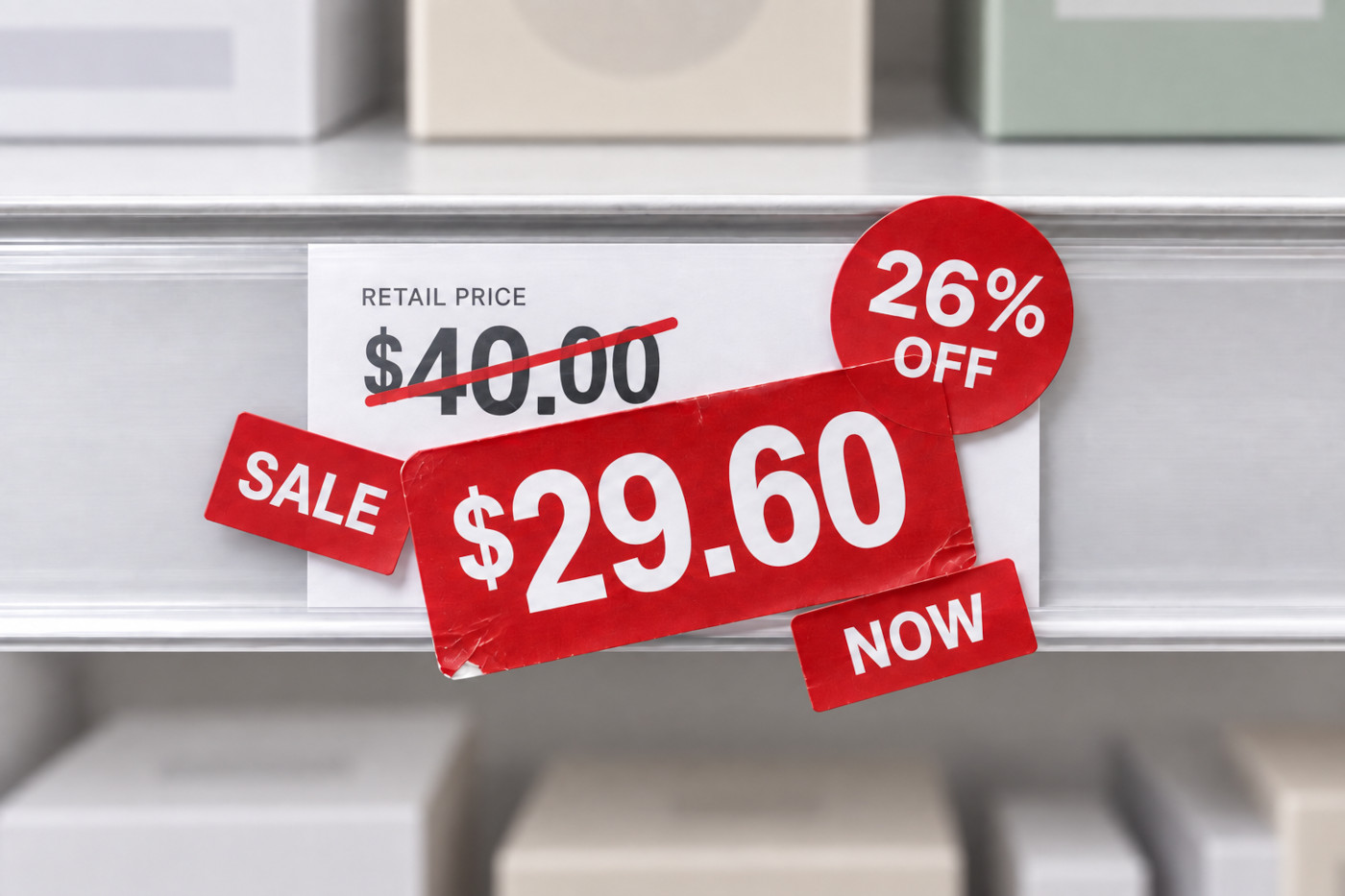
Across 12 United States cannabis markets tracked by Headset, the average discount rose from 22.8 percent in June 2025 to 26.0 percent in June 2026. At the same time, average item prices fell 3.3 percent, while the effective price of packaged flower declined 5.7 percent per gram. Headset noted that more than a quarter of shelf value is now being given back at the register.
At that level, discounting is no longer a modest promotional adjustment. It is a pricing habit.
- Average cannabis discounts rose from 22.8 percent to 26.0 percent year over year across 12 U.S. markets tracked by Headset.
- Frequent promotions can reset shoppers’ reference prices, making the discounted price feel normal and the full price inflated.
- Larger flower packages suggest consumers increasingly are shopping for unit value, not simply the lowest sticker price.
- Retailers can protect margins by giving every promotion a specific job and measuring what happens after the discount ends.
For retailers and brands, the question is not simply whether consumers like discounts. Of course they do. The harder question is what repeated discounting teaches them about the underlying value of a product.
When 20 percent, 25 percent, or 30 percent off appears often enough, the marked price begins to lose credibility. The discounted price becomes the reference point in the shopper’s mind. Meanwhile, the full price starts to look inflated, temporary, or avoidable.
That creates a difficult cycle. Retailers use promotions to drive traffic, clear inventory, defend market share, and compete with stores down the street. Brands often participate because they need velocity and shelf space. But the more frequently discounts appear, the more difficult it becomes to persuade consumers to buy without one.
In effect, the promotion can start competing with the product.
The sticker price may no longer be the real price
This problem is familiar far beyond cannabis. Retailers in mature consumer categories have long wrestled with customers who learn to postpone purchases until predictable promotions arrive.
Cannabis may be reaching a similar point unusually quickly.
A shopper who sees a $40 eighth marked down to $30 every weekend may stop thinking of it as a $40 product. Instead, it’s a $30 product with an occasionally inconvenient sticker.
Once that expectation takes hold, raising prices becomes harder, reducing discounts can seem like a price increase, and promotional events lose some of their urgency because customers assume another one is coming soon.
That’s especially significant in cannabis, where price compression already has narrowed margins in many mature markets. Discounting can increase unit movement while simultaneously weakening the economics of each sale.
Consumers are getting better at shopping for value
Headset’s data suggest shoppers are not simply chasing the lowest sticker price. They’re also shifting toward larger flower package sizes, where the cost per gram generally is lower. According to Headset’s report, that shift was strong enough between last summer and this summer that the average flower item price rose slightly even as the effective price per gram fell.
The shift suggests consumers may be becoming more sophisticated about unit economics. Instead of asking only, “What costs less?” they increasingly may be asking, “Where do I get more for my money?”
For retailers, that can change merchandising strategy.
A larger package sold with a modest discount may produce a healthier basket than a heavily discounted eighth. Multipacks and other value-oriented formats may accomplish some of the same work as blanket promotions without conditioning shoppers to expect 25 percent off everything.
Brands face a similar calculation. If retailers routinely discount their products, wholesale pricing, suggested retail pricing, and promotional allowances eventually have to account for that reality. Otherwise, MSRP risks becoming little more than a number printed before the strike-through.
Promotions work best when they still feel promotional
None of this means discounts are inherently bad.
They can introduce shoppers to new products, revive slow-moving inventory, reward members, create urgency, and provide a reason to visit a certain store instead of its competitor.
The danger comes when there is no meaningful distinction between promotional pricing and everyday pricing.
If nearly every purchase happens under some form of discount, retailers lose one of promotion’s most useful characteristics: contrast. A sale works partly because customers perceive an unusual opportunity. When the opportunity becomes permanent, urgency disappears.
The industry already has seen what happens when product abundance outpaces demand. Price compression follows, margins tighten, and operators compete harder for the same customer. Perpetual discounting may be accelerating the same dynamic at the register.
Cannabis does not necessarily have a discount problem. It may have a reference-price problem.
And if shoppers now believe the real price is 26 percent below the one on the shelf, retailers may have a much harder time teaching them otherwise.
Before cutting the price, ask what the discount is supposed to do
Not every promotion needs to disappear. But retailers and brands may benefit from treating discounts as tools with specific jobs rather than default pricing mechanisms.
Before slashing prices, operators can ask a few basic questions:
- What behavior are we trying to change? Is the goal to attract new shoppers, increase basket size, move aging inventory, introduce a new product, or reward repeat customers? If the answer is simply “drive sales,” the discount may be too blunt.
- Would a different offer accomplish the same goal? Bundles, larger formats, member rewards, gifts with purchase, or targeted offers may create value without lowering the perceived worth of every item on the shelf.
- Are shoppers buying more, or merely paying less? A promotion that increases units but reduces gross profit may look successful in transaction data while weakening the business.
- How often has this product been discounted recently? If customers rarely encounter the item at full price, the promotional price may already have become its reference price.
- What happens when the promotion ends? If sales collapse immediately, the discount may not have created demand. It may simply have rented it.
The larger lesson may be that cannabis does not need fewer promotions so much as more intentional ones.
A 26-percent discount can be a useful sales tool. It becomes a problem when nobody remembers what the full price was supposed to mean.