

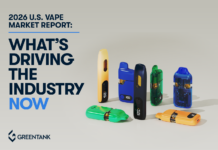





When adult-use cannabis markets first began to roll out, vape products were an afterthought. They seemed like an experimental category built on borrowed nicotine technology and overshadowed by flower’s cultural dominance.
A decade later, the hierarchy has flipped.
- Hardware divergence: The shift from repurposed nicotine “e-liquid” tech to purpose-built cannabis hardware solved chronic performance issues like clogging and leaking.
- The EVALI effect: While devastating, the 2019 health crisis forced the legal industry to adopt unprecedented levels of transparency, effectively “maturing” the market.
- Transparency as a commodity: COAs (Certificates of Analysis) and QR codes transitioned from regulatory burdens to essential brand trust markers.
- Market bifurcation: The category is splitting into two distinct lanes: high-potency, price-driven distillates and premium, “true-to-plant” live resin/rosin formats.
In many of the world’s largest cannabis markets, vapes are no longer a secondary option; they’re the main event. The shift is striking not just because of its scale, but also because of what happened in the middle. In 2019, the EVALI crisis sent shockwaves through the industry, collapsing consumer trust and triggering regulatory crackdowns many believed would stall the category.
Instead, vapes did something rare in cannabis: The category recovered and then accelerated. Today, vapes sit at the intersection of convenience, technology, and consumer evolution, giving the industry a fundamentally different kind of business.
Why nicotine-based tech failed the cannabis market
In the early years of legalization, vape hardware wasn’t designed for cannabis at all. It was adapted — usually imperfectly — from nicotine devices, and that mismatch created a ceiling on performance and trust.
“In the early advent of cannabis legalization, vapes were built on the backbone of the nicotine industry,” said Derek Champoux, vice president of brand and marketing at Greentank Technologies. “Those who work in the industry know [nicotine] e-liquids and cannabis extracts are worlds apart and thus behave differently inside a vape device.”
Over time, the gap became a catalyst for innovation. Manufacturers invested heavily in research and materials, rethinking how cannabis oil interacts with heating elements and airflow systems.
“Over the past ten-plus years, manufacturers have put a ton of resources into [research and development], studying the oil-to-coil interaction, upgrading specific key materials like ceramics, glass, medical-grade alloys, etc., to improve safety, performance, and reliability,” Champoux said.
The result is a category that now delivers on the fundamentals consumers expect: consistency, flavor, and reliability.
“At the end of the day, the consumer wants a vape product that is going to give them the best experience,” Champoux said. “That includes no clogs, no leaking, consistent vapor, and flavorful, true taste every time they grab their device.”
The EVALI crisis: a turning point for supply chain integrity
If early hardware limitations slowed adoption, the EVALI crisis nearly stopped it altogether.
EVALI, formally known as “e-cigarette or vaping product use-associated lung injury,” is an acute respiratory illness that struck seemingly without warning in April 2019. By January 2020, the disease had left 2,668 people hospitalized and sixty-eight dead. Most victims were between the ages of eighteen and thirty-four. Eventually, the U.S. Centers for Disease Control and Prevention determined the syndrome likely was triggered by the presence of vitamin E acetate in THC vapes victims purchased primarily on the illicit market.
Nevertheless, suspicion fell on the legal industry. The 2019 outbreak exposed deep vulnerabilities across the cannabis supply chain, from unregulated additives to substandard hardware. For consumers, the distinction between legal and illicit blurred, and trust collapsed across the board.
“The EVALI scare stemmed from the gray and black markets,” Champoux said. “What we really learned from that event is that cannabis needs more regulation, to ensure only vetted and reputable consumer brands are making their way onto legal retail shelves.”
The regulatory response, while predictable, created unintended consequences. In trying to protect consumers, some markets tightened regulations so much that illicit markets became the only source for consumers seeking vaping products.
“The adverse effect spawned by EVALI was regulators getting scared and banning all vape products, which only pushed more responsible consumers back into the black market,” Champoux said. “It became a vicious cycle that only reaffirmed the safety gap in the vape space.”
How regulatory pressure became a catalyst for product innovation
For brands, the moment exposed both a product problem and an integrity issue.
“The EVALI crisis exposed a sad truth in the cannabis industry,” said Dan Michaels, vice president of product at Jaunty, a vape and cartridge brand that debuted in January 2023. “There were certain brands that unfortunately took advantage of loopholes in the system in an effort to cut costs and turn a quick profit. Unfortunately, they cut corners by using cheap or bootleg hardware, which can leach toxic heavy metals, or by diluting their cannabis oil with other substances that are harmful when vaped.
“What’s changed in today’s market is that consumers are demanding transparency in labeling and ingredients, verified third-party testing, and [Good Manufacturing Practices] certification,” he continued. “With that comes a responsibility not all brands can handle, so we’re now seeing in real time who’s rising to the top shelf at licensed dispensaries and who’s still feeding the unlicensed market questionable product.”
Transparency becomes the product

The recovery was engineered through stricter standards, better products, and better-informed consumers. But more than anything, it required the legal market to clearly separate itself from the illicit market.
That shift toward accountability has become a defining feature of the legal market. In many ways, vapes became the category where the industry had to grow up fastest.
“One silver lining was the way responsible operators across the legal industry rallied around health, safety, and transparency,” said Laura Fogelman, vice president of communications and chief of staff at PAX. “There was a real recognition that one bad actor can put the entire category at risk, and that cannot be tolerated.”
The result is a level of disclosure that now exceeds the standards in other regulated industries.
“Many cannabis brands now provide a level of disclosure that goes beyond what consumers see in most other sectors, from QR codes and lab results to clearer information about additives and formulations,” Fogelman said.
In a category once defined by uncertainty, transparency is now part of the product itself.
Today’s consumers know exactly what they want
If early vape consumers were driven by novelty, today’s are driven by intent.
Across markets, preferences have sharpened. The question is no longer whether to buy a vape, but which one and why.
“It’s no longer just ‘I want a vape,’ but more specifically ‘I want live resin,’ ‘I want something that tastes good,’ ‘I want the strongest option,’ or ‘I want something that feels true to strain,’” said Brandon Gilmour, brand manager at multistate retailer Insa.
That evolution reflects a broader shift in expectations: Consumers aren’t buying just the format anymore. They’re buying the experience.
“Consumers want convenience,” Champoux said. “Outside of that, they are looking for reliability; clean, flavorful vapor; and a product that ultimately fits their lifestyle.”
And they want everything in one tidy package, Jaunty’s Michaels added. “Convenience, consistency, and care,” he said. “Everything from flavor and effect to vapor clouds and smoke-like sensation dialed in, optimized, and nicely packaged in a discreet format.”
According to Fogelman, no single attribute is driving growth in the category. What does make a difference, she said, is that vapes deliver everything consumers want, and they do it with increasing consistency. “Consumers want convenience, discretion, faster onset, controlled dosing, strong flavor, and options at every price point, and vapes deliver on all of that.”
Hardware, oil, and a bifurcating market

As the category matures, several clear trends are shaping both product development and purchasing behavior. Notably, the trends don’t all point the same way: Hardware is going bigger while format preferences are splitting at both ends.
On the hardware side, convenience and control are driving innovation.
“Consumers are definitely grabbing higher capacity devices, with reservoirs of 2ml or larger, simply out of convenience,” Champoux said. “Other interesting trends we’re seeing are the growth in the all-in-one category, especially palm-style designs, LED displays, variable heat control, and even dual reservoirs.”
But the oil inside the device is just as important as the hardware.
“Here in New York, we’re seeing a strong desire for all-in-one devices, especially in the City,” Michaels said. “At the end of the day, the hardware and the cannabis oil are like the yin and yang to an overall enjoyable experience, and we’re investing heavily into our [research and development] on both fronts.”
That balance is reflected in a bifurcating market.
“Distillate will remain an important part of the category, because price and potency still drive a huge amount of consumer behavior,” Fogelman said. “But we’re also seeing more consumers develop real preferences around flavor, extract quality, and lower-intervention formats.”
Formats are diverging as well. Michaels pointed to growing demand for both ends of the spectrum, with experienced users seeking “larger capacity formats of three grams plus” and “smaller formats of .5 grams or less” attracting trial and occasion-based consumers.
High demand, squeezed margins, and the curation imperative
For retailers, vapes bring an interesting mix of repeat and new business, but not without challenges.
“Vapes are an important category from a retail standpoint, because they tend to drive repeat purchases and can be a strong part of the business when the assortment is right and pricing is managed well,” Gilmour said.
Nevertheless, high demand does not automatically translate into high profitability.
“In competitive markets, pricing pressure can become intense, and margins can get squeezed quickly when the market becomes too promotional,” Gilmour said.
Operational complexity is another hurdle.
“One of the biggest challenges in the vape category is how crowded and complex it can be,” Gilmour said. “There are a lot of products, a lot of claims, and a wide range of technologies and extraction types being presented to consumers.”
That can lead to “decision paralysis,” which encourages consumers to play it safe by sticking with older products they know are reliable instead of trading up to newer, more profitable devices. Even worse, inexperienced consumers who find their first vaping experience disappointing may abandon the format entirely.
“A vape that clogs or burns badly is going to lose people quickly, regardless of how strong it is,” Gilmour said.
The solution? Better curation.
“Retailers can address these challenges by curating their assortment more thoughtfully, training staff effectively, and making the category easier to navigate,” Gilmour said. “The easier the category is to understand, the better the overall customer experience tends to be.”
The future of vape technology: personalization and harm reduction
If the past decade was about proving vapes could survive, the next will be about defining how they evolve.
Hardware innovation is never ending, particularly around safety and efficiency.
“With more and more complex formulations . . . the engines of these devices need to adapt,” Champoux said. “Manufacturers need to ensure safety is at the forefront while maintaining optimal end-user experience.”
At the same time, consumers are becoming more intentional in their purchases.
“We expect the category to continue moving in a more health-conscious, harm-reduction direction,” Fogelman said.
And while formats and formulations will continue to diversify, the core value proposition remains the same: Vapes must fit modern life — portable, precise, and increasingly personalized. But more importantly, they must fit modern business: repeatable, scalable, and increasingly predictable. That alignment, more than any single innovation, may be what ultimately cements vapes’ place at the top of the cannabis hierarchy.
The rise of vapes is a case study in how a cannabis category can evolve under pressure: forced to innovate, standardize, and earn back trust in real time. In an industry still fighting for legitimacy, that kind of evolution carries weight.
The path forward: resilience as an industry standard
The rise of vapes is a case study in how a cannabis category can evolve under pressure: forced to innovate, standardize, and earn back trust in real time. As hardware reaches new levels of sophistication and transparency becomes the industry baseline, the category has moved beyond simple survival. In an industry still fighting for federal legitimacy, the vape sector’s successful pivot from a 2019 crisis to a 2026 market leader serves as a blueprint for resilience across the entire cannabis landscape.