
As some of the world’s largest food manufacturers scramble to reformulate products in response to growing pressure to eliminate synthetic food dyes, one small cannabis ingredients company quietly arrived at a solution to one of food science’s most stubborn problems: producing a stable, all-natural blue.
Melt-to-Make, a cannabis ingredients manufacturer specializing in edible formulations, cracked the code thanks to a registered dietitian’s relentless quest for “blue raspberry.”
- Natural blue remains one of food formulation’s most difficult colors because it can shift or fade under heat, acidity, light, oxygen, and time.
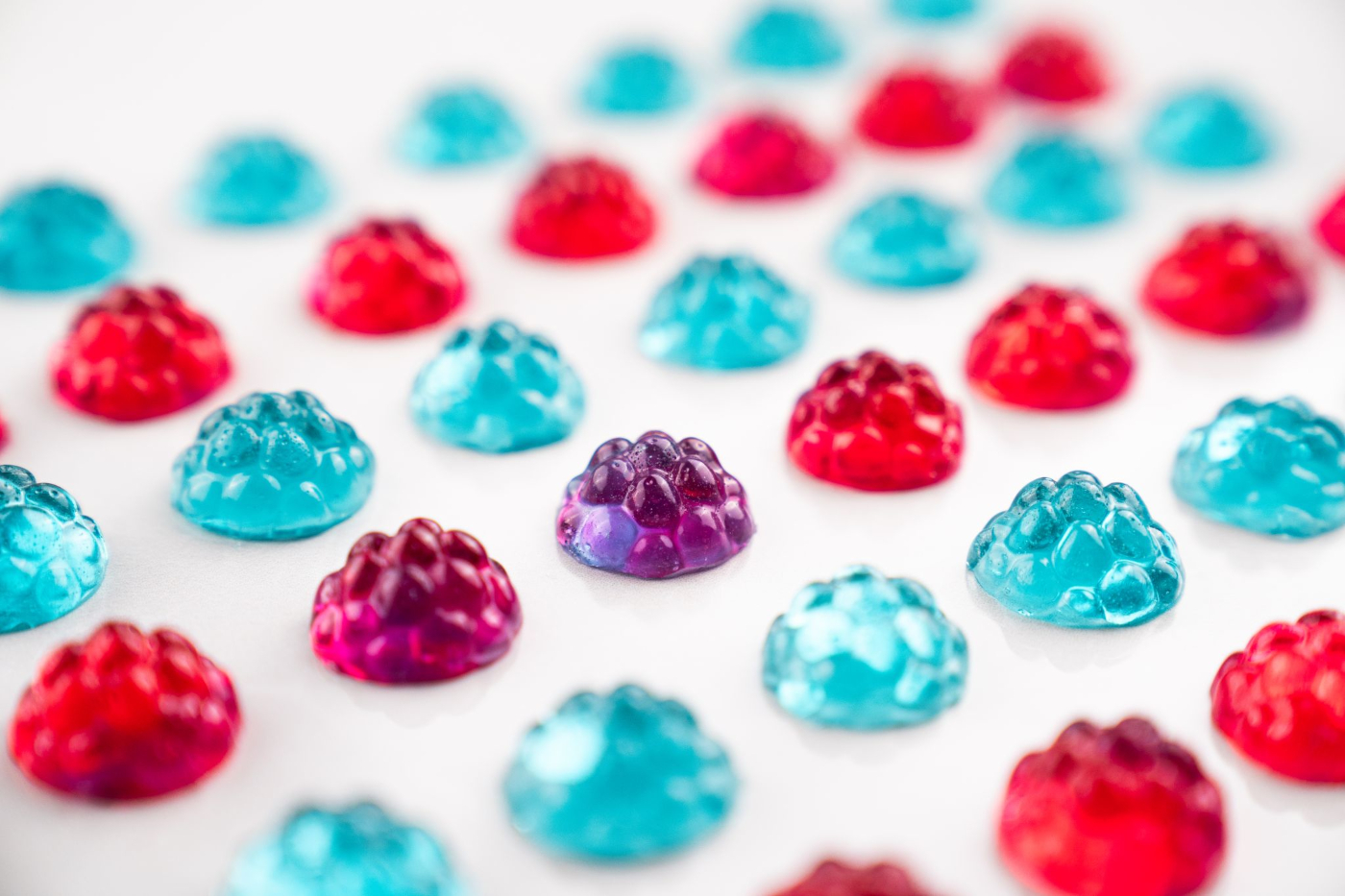
- Melt-to-Make developed vivid natural-blue gummy formulations through years of testing ingredients, processing conditions, and shelf-life variables.
- The company also found that, in some applications, moving color from the gummy itself to a sanding-sugar coating could create a more reliable result.
- The breakthrough illustrates how cannabis product-development teams can solve technical problems before larger consumer-packaged-goods companies do.
The issue raised its head in a big way in June, when Mars Inc. — one of the top five global food and beverage corporations, with $55 billion in annual revenue — was forced to admit defeat, at least temporarily. In attempting to comply with Health and Human Services Secretary Robert F. Kennedy Jr.’s Make America Healthy Again initiative, the company has been having a devil of a time finding a natural replacement for the synthetic blue dye used to create the iconic blue and brown M&M’s. Consequently, those two colors will be missing from a new, all-natural M&M’s product line.
It’s an amusing twist for an industry that has spent decades chasing legitimacy: This time, cannabis beat the food giants to the answer.
Unlike conventional confectionery, which spent decades optimizing for scale, shelf life, and manufacturing efficiency, legal cannabis grew out of a medical movement. Many of the earliest consumers weren’t simply looking for something sweet. They were patients searching for alternatives to pharmaceuticals, cancer patients navigating treatment, and health-conscious consumers who scrutinized ingredient labels long before it became fashionable.
That distinction shaped product development. Traditional food manufacturers were rewarded for consistency, affordability, and mass production. Cannabis companies, by contrast, were often challenged by consumers who wanted cleaner ingredient lists, greater transparency, and products that aligned with broader wellness goals.
So while multinational conglomerates used Food, Drug, and Cosmetic Act-approved artificial substances to perfect blues because they were inexpensive, vibrant, and remarkably stable, Melt-to-Make invested years trying to answer a much harder question: What if every ingredient had to come directly from nature?
Blue: more than meets the eye
Natural red dyes come from berries and yellow from turmeric, but blue occupies a far smaller corner of the “nothing artificial” world. Outside of ingredients like spirulina and butterfly pea flower, formulators have remarkably few options, and the ones they do have come with significant compromises.
Spirulina is highly sensitive to heat. Butterfly pea flower dramatically shifts from purple to pink depending on acidity and can fade when exposed to light. Add commercial production, packaging, oxygen exposure, and months of shelf stability, and producing a simple blue candy becomes an engineering challenge as much as an aesthetic issue.
“In our application, you’re dealing with heat, acidity (pH), and light and oxygen exposure, depending on packaging,” said Sarah McLaughlin, MS, RD, who leads formulation work at Melt-to-Make. “Natural colors are really sensitive. It’s not to say synthetic colors aren’t, but they aren’t anywhere as sensitive. And blue is really tough. If you think about it, there’s not a lot of blue in nature.”
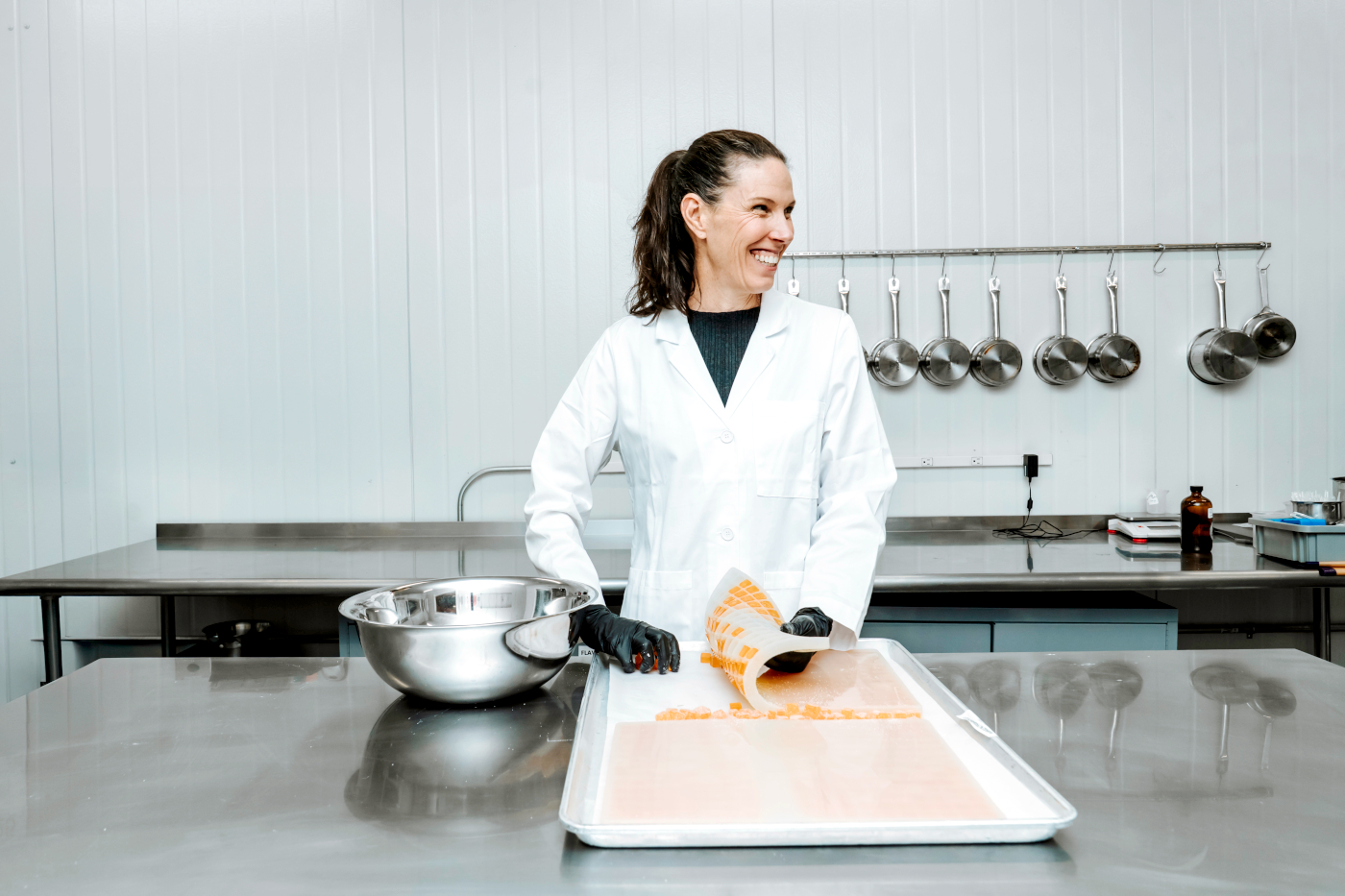
McLaughlin understands the challenge of going all-natural better than most. Long before consumers began paying attention to artificial dyes, she was already trying to eliminate them.
When she co-founded Melt-to-Make, the company wasn’t interested in creating another gummy. It wanted to create one without compromise.
“I’m a dietitian,” she said. “I came from the natural-foods world, so I’ve always been all about natural, no matter how challenging it was. In fact, I was borderline stubborn about it.”
That stubbornness turned into years of research.
“When blue first came into question for us, it was because one of my business partners told me, ‘Sarah, people love blue raspberry.’ And I was like, okay, if I can find a natural blue raspberry flavor, we can roll with that. And I found it. So then I was determined to figure out the color blue beyond just the flavor,” McLaughlin said.
Early successes proved deceptive. One formulation looked beautiful immediately after production, only to fade after several weeks under retail lighting. Another produced vibrant gummies until the addition of citric acid shifted the chemistry.
“I couldn’t assume just because it looked beautiful when I made it, it would stay that color,” McLaughlin said.
That realization changed how the company approached formulation.
Developing a natural blue wasn’t about simply identifying the right ingredient. It meant understanding how time, temperature, acidity, oxygen, packaging, and manufacturing scale all interacted.
Every adjustment solved one problem while threatening to create another. Even today, McLaughlin describes production as a carefully managed race against the clock.
“We’ve got that blue, but we only have so many minutes in we can deposit it before it may change,” she said.
Ironically, solving blue created entirely new problems. Brown, for example, is brown because it contains blue, and green combines blue and yellow. So, any instability in the blue component quickly cascades into other colors, creating issues throughout an entire product portfolio.
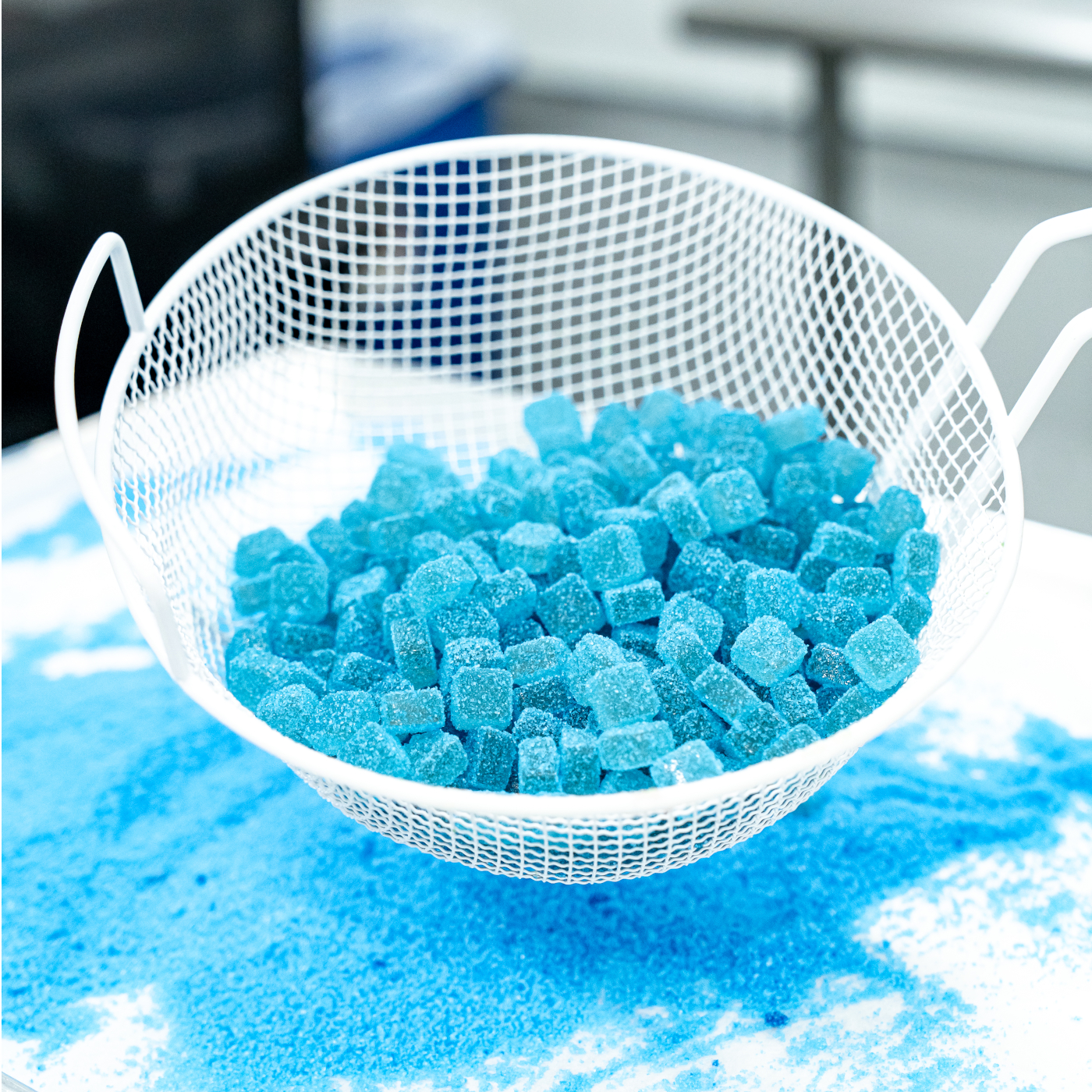
Rather than continuing to fight chemistry, Melt-to-Make began asking a different question: If the gummy itself couldn’t reliably carry the color, could something else?
One of the company’s most successful previous innovations came after McLaughlin spotted blue sanding sugar at a trade show. Instead of coloring the gummy itself, particularly for higher-temperature pectin formulations, she wondered whether the coating could carry the color instead. The answer was yes.
It’s a deceptively simple solution, but one that reflects an important truth about innovation: Sometimes breakthroughs aren’t about inventing entirely new technology. They’re about looking at the same problem from a different angle.
Innovation follows incentive
That mindset may explain why cannabis found an answer before traditional confectionery: Cannabis consumers demanded it sooner.
“A lot of people take cannabis as an alternative to pharmaceuticals or sleep or pain medications,” McLaughlin said. “So, if you’re already looking for that alternative, that means you probably already care about what you’re putting in your body, and you wouldn’t want to consume synthetic colors.
“There are people in the food industry who’ve been doing natural colors already, like Whole Foods and Trader Joe’s,” she continued. “That’s what told me this was possible. Or even traveling to Europe and buying gummies there. You have this moment of, ‘Wait, they’re [using natural colors].’ And I think the cannabis space generally cares more about what people put in their bodies. We’re more open to trying an alternative in order to do the right thing.”
That expectation extends well beyond color.
“It’s not just the color for us,” McLaughlin said. “All of our ingredients are natural, safer for allergies, etc. We really have a commitment to that in the cannabis space. When my business partner told me to develop a gummy, I laughed. A dietitian developing a gummy… okay. If I do that, it’s going to be natural.”
Viewed through that lens, Melt-to-Make’s natural blue isn’t really a cannabis story — or even a candy story. It’s a story about incentives, and those worlds are beginning to converge. As consumer expectations shift and regulators increasingly scrutinize artificial ingredients, natural-color technology is becoming less of a niche curiosity and more of a competitive advantage. McLaughlin nodded to emerging innovations like Galdieria extract, a new algae-derived color with greater heat tolerance, as evidence natural color science is advancing rapidly.
The irony is hard to ignore. For years, cannabis looked to mainstream consumer packaged goods for inspiration. Today, one of those mainstream industries finds itself confronting a problem that a cannabis company quietly solved. For an industry accustomed to playing catch-up, it’s a rare and satisfying role reversal.